
This post was originally published on this site.
—
Native Canadian Ryan Reynolds is making headlines, and this time it’s not for being married to Blake Lively. The actor, born in Vancouver, Canada, spoke with reporters in New York City while promoting his new picture, “Mayday,” waxing nostalgic about the good old days. “The 80s was a brutal, brutal time for people. It was a f*cking mess and people forget that.” We get you, Ryan from Canada. Totally legit he explained the mindset of the era, the peak year of which — 1986 — he was nine years old, and how the Cuban Missile Crisis and presumably Carter-era inflation and socioeconomic unrest created an aura of general suckiness: “When you get far enough away from a time period that’s quite distinct, there’s always a lovely feeling associated with it, almost like you pave over all the trauma with puppy dogs and ice cream.”
Ryan Reynolds says ’80s nostalgia “paves over all the trauma” of the “tumultuous” decade:
“The 80s was a brutal, brutal time for people. It was a fucking mess and people forget that. It was a tremendous strife. Socio political tensions everywhere. We were still pretty fresh off… pic.twitter.com/CvNE3KLfff
— Variety (@Variety) September 2, 2026
Correct. As a child of the ’80s myself, I can see why Reynolds talks so frankly about the deep trauma he experienced; it must have been awful for him living in Canada. But those of us on the cool side of the international border see the decade a whole lot differently — and we don’t chalk it up to puppy dogs and ice cream (though there were plenty of those to go around in the Land of the Free).
We should cut Ryan from Canada a little slack; after all, it probably was difficult to see the best that your country has to offer in that glorious decade, cut and run from it to the U.S. faster than your health care system is euthanizing old people.
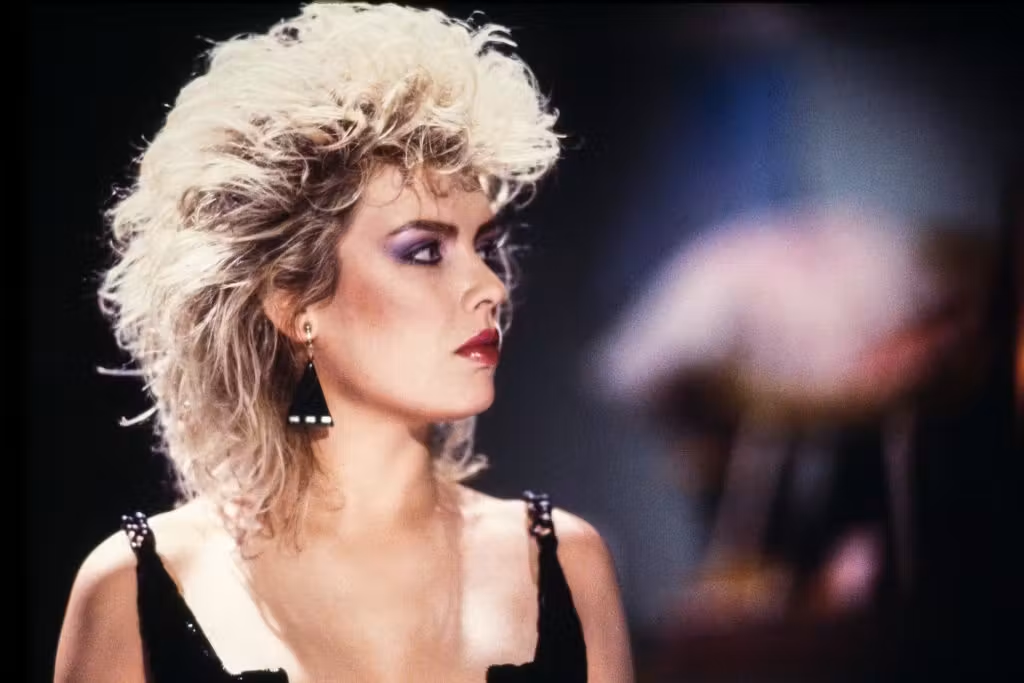
Maybe it was the hair? I admit things got pretty out of control, but there must be a correlation between out-there hair trends and good times. The Roaring ’20s had the bob, the 1950s had beehives, and the 1980s had well, this:
Credit: FG/Bauer-Griffin/Getty Images.
No one made Ryan get a mullet, but perhaps his delicate, trauma-prone eyes were scandalized by a few flowing dude-cuts while he was practicing his duck-and-cover. Speaking of hockey-hair, 1980 was the year America set the tone for the decade with an absolute banger of a hockey game. Maybe Ryan has heard of it; they did make a movie about it. And hockey is one of the sports Canadians are fairly decent at, at least when they aren’t cheating.
Contrary to Reynold’s misplaced reminiscences, the world wasn’t quite the expletive-laden, smoldering tinderbox he says it was. It was a time when the cracks were showing that would eventually break the Berlin Wall and the U.S.S.R. And sports is a good place to start: we crushed the Reds in Lake Placid to start the decade and by 1986, we held the Goodwill Games, where the American and Russian athletes finally competed in a spirit of well, goodwill, after the back and forth of boycotts and wars. And if you count soccer as a sport, the world did unite in awe at Argentinian Diego Maradona’s “Hand of God” and “Goal of the Century” performance at the 1986 FIFA World Cup.
But America at that time wasn’t really into sitting around watching soccer. And we weren’t paralyzed with fear at the prospect of nuclear war.
We had a president who played hardball when it counted, and we were secure in the knowledge that America was done fearing its own power. It was that self-confidence that shaped a decade, schlepping its way out of shag carpet conversation pits and striking out on a path that would lead the world out of the grips of communism.
Far from the “tremendous strife” of Reynolds’s claims, the 1980s were an explosion of innovation-meets-optimism that lacked much of the weirdo-scaredness at the fringes of the 1950s Space Age with its radiation monsters and alien invasions. Instead of Japan’s “Godzilla,” we got Japanese cars and “Gung Ho.” Not every family had a DMC DeLorean parked in the driveway, but new-fangled technology became accessible to millions of American families. Sony released the TPS-L2 in 1980 and teenage culture never had it so good.
By the mid-’80s, that device, popularly known as the Walkman, was selling for $30 for a basic model. Along with color television, homes had Video Home Systems and could rent a videotape on Friday night and return it Sunday on the way home from church (please be kind, good Christians — rewind!). Computer networking was in its infancy, and personal computers were on the consumer horizon.
Not too many high schoolers were at the mall food court discussing the latest statecraft motives of the Kremlin. Rather, a normal American kid was bopping through the mall to his job at the Orange Julius, where he made enough money to fill the gas tank on his 1972 Oldsmobile Cutlass Supreme with wood grain dash trim and Strato bucket seats, save for a new Swatch watch, and have enough left over to meet his buddies at the arcade and catch “Top Gun” at the movie theater.
Kids rode Huffys down to the dollar store and bought a Coca-Cola. We called each other from landline phones with impossibly long cords that wound around themselves a half dozen times. Your kid sister had a Care Bear, and you played Mario on the NES. Malls were decked out in neon that matched your crushes’ spandex leggings — a hypnotic blur under the pulsing lights of the local roller rink. MTV killed the radio star and Michael Jackson killed the beat. And the only thing worth worrying about was if you could convince your folks to let you see “The Terminator” on Friday night.
So, Ryan from Canada, even if what you say is true — that the objective events of the era were pretty busted — the difference is that the people who shaped how those events were reflected in society and the culture at large didn’t wallow in fear or “strife.” They didn’t make the “trauma” their identity. They persisted. They made do — because that’s what Americans are all about, at least they used to in the 1980s, which is what made that time special. Americans put a cassette in the boombox and hit the mall in a rad fluorescent polo, acid-wash jeans, and a pair of wayfarers and never looked back.
This is the glaring problem with social media and self-absorbed celebs today: they pick up on the doom and gloomers and spread that negative zeitgeist like a Canadian wildfire. People like Ryan want us to think the awesomeness of that era was nothing more than a fuddy-duddy nostalgia pipe dream so that we can’t confidently compare what we had then with what we have now — whatever this is — and lament how much has deteriorated and how much of what we loved then is missing from America now.
Heck, even in the ’90s, just before Reynolds was the rebound guy for Alanis Morissette — the hero of every screaming-at-the-sky Lilith Fair feminist — things were pretty doggone good. In fact, I’d wager good money that Reynolds’s “trauma” might have more to do with living in the shadow of another person or country than a decade that saved us from Earth Shoes and disco and gave us Memphis Milano and Van Halen. “Living out loud” wasn’t just a Body Glove T-Shirt slogan; it was a way of life. And a pretty good one at that.