This post was originally published on this site.
—
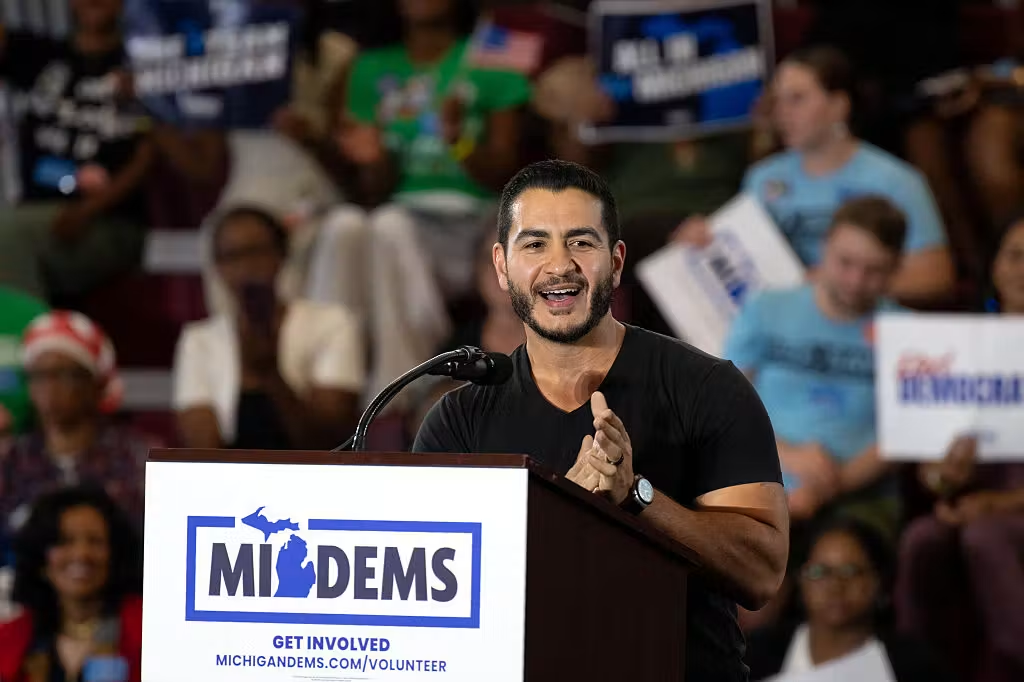
Michigan Democrat Senate candidate Abdul El-Sayed kept a book on his shelf written by an Islamic scholar linked to the 1993 World Trade Center terrorist attack.
The book, called “Dream Interpretation According to the Qur’an,” was written by Abu Ameenah Bilal Philips, an Islamic scholar listed as an unindicted co-conspirator in the first bombing attack on New York’s World Trade Center. The book was just one of several tied to radical Islam seen on El-Sayed’s shelf in resurfaced documentary footage.
In the footage, El-Sayed asked the film crew to avoid filming his bookshelf. He told them, “You’re going to want to not get these things in the shot … we’re trying to keep the shot secular.”
The details on El-Sayed’s book collection were flagged by the Washington Free Beacon on Wednesday as the Michigan Senate candidate continues to face questions about his ties to radical Islam. A new report Tuesday showed that El-Sayed’s mother worked for an American-based Islamic charity accused of financing Osama bin Laden.
Throughout his public work and advocacy, Philips defended Muhammad’s marriage to a young child, appeared to justify suicide bombings as a “military action,” and has been banned from multiple countries.
Other books on El-Sayed’s shelf included “Reflections on the Quran” by Irfan Ahmad Khan and “A Thematic Commentary on the Qur’an” by Sheikh Mohammed al-Ghazali. Khan was “active” in the movement pushing for India to be governed by Sharia law before he moved to the United States, while Mohammed al-Ghazali was a member of the Muslim Brotherhood.
In the 1990s, Mohammed al-Ghazali testified in support of 13 Egyptian terrorists who gunned down a man who did not support Sharia law. During the trial, Mohammed al-Ghazali said that “the refusal of implementation of Sharia is apostasy,” adding that the death penalty was an acceptable punishment for apostasy under Islamic law.
El-Sayed has also faced questions about previous comments he made to The New York Times about committing to following Sharia law.
“Ultimately, the question is, when I die and I stand before God and go through everything I did in my life, I don’t want to say I did it the easy way instead of the Shariah-compliant way,” he said in 2009. “Not because of fear but because of obligation.”