This post was originally published on this site.
—
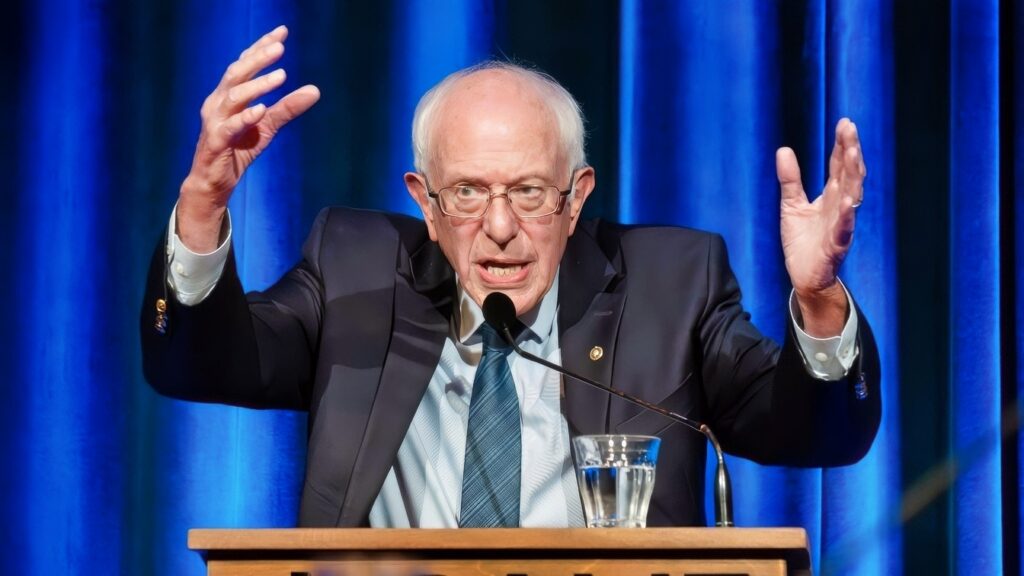
With Democrats returning to the Senate in January with their largest majority in years, 56-44, progressive Vermont Senator Bernie Sanders—technically an Independent who caucuses with the Democrats—already knows what he’ll be pushing for.
Sanders, who is set to chair the Senate Committee on Health, Education, Labor, and Pensions, said he plans to push hard to pass a universal healthcare bill, which he also hopes President Donald Trump will sign.
Donald Trump Speaking at Event in 2024. Creative Commons Photo.
A Four-Year Plan for Medicare for All
Sanders says his plan will eventually cover all Americans with government-funded medical insurance in four years.
The first year would begin by lowering the eligibility age from 65 to 55.
Coverage would also expand to include dental, vision, and hearing services, and children up to age 18 would be guaranteed health coverage.
In the second year, eligibility would drop again, this time to 45, then to 35 by the third year. In the fourth year, all Americans would be covered.
Sanders says the plan will be funded primarily by shifting financing from private premiums to payroll contributions, along with higher taxes on wealthy individuals and companies.
More than Just a Pipe Dream
Giving Americans universal healthcare has long been championed by the Vermont senator, who even attempted to use the measure as a capstone of two failed presidential runs.
Until recently, Sanders has been skeptical about whether a universal healthcare measure was still viable.
In 2023, Sanders described the American healthcare system as “dysfunctional” and said it “needs to be fundamentally changed to a Medicare for All system — but we ain’t gonna get it.”
In November last year, he wrote to Democratic colleagues in the Senate, saying that “this [Medicare for All] bill does not yet have majority support in the Democratic caucus.” In his letter, he also asked for Democratic support for related initiatives, including extending enhanced Affordable Care Act (ACA) tax credits, cutting drug prices in half, and repealing $1 trillion in cuts to Medicaid and the ACA.
President Donald J. Trump delivers remarks at the UP.Summit technology showcase at NASA’s Kennedy Space Center at Cape Canaveral, Florida, Friday, November 6, 2026. (Official White House Photo by Patrick Witty)
Even now, Sanders has no illusions about how hard the path forward for the still-unpassed initiative will be.
“Transforming a system which is 18% of the GDP of America, you don’t do that overnight,” the Vermont senator said.
At the very least, though, Sanders says the first stage of his plan can clear the Senate through a budget reconciliation process, which requires only something the Democrats already have—a simple majority.
Do Americans Support Universal Healthcare?
According to research firm KFF, most Americans—66%—support Medicare for All. The caveat is that the number fell to roughly one-third of Americans when they found out that it would mean higher taxes.
None of Sanders’ past proposals (which he has been filing as early as 2017) include a Congressional Budget Office (CBO) cost estimate.
In 2022, the CBO released figures showing that the US would add $155 billion to its budget deficit by lowering the eligibility age to 60.
As it stands, the US deficit has already reached approximately $2 trillion, or 6.2% of the country’s GDP.
How About Democratic Support?
While Sanders may still be holding on to hope, Democrats seem to be divided of the issue.
In August, House Democratic leader and New York Representative Hakeem Jeffries said that a universal healthcare bill was “not legislation that I currently am cosponsoring or that I support.”
Jeffries added that even just lowering the age of eligibility for Medicare was only an “ongoing conversation.”
Another prominent Democrat, Oregon Senator Ron Wyden, said he supports Medicare for All but was less committed on whether the issue will be debated in the next Congress.
Wyden is poised to chair the Senate Finance Committee next year
Others, like California Representative Ro Khanna, largely agree with Sanders. Khanna called a universal healthcare bill “arguably the most important priority” for the new Democratic-led Congress.
Republicans Oppose Universal Healthcare
For the White House’s part, a universal healthcare initiative is a big no-no.
“The Radical Democrats’ socialist proposal for a government takeover of healthcare should really be called ‘Medicare for None’ as it destroys access to the life-saving care Americans rely on daily,” White House spokesperson Allison Schuster told Fox News.
About the Author: Tim Ramos
Tim Ramos has written for various publications, corporations, and organizations, covering everything from finance, politics, travel, entertainment, and sports – in Asia and the U.S. for more than 10 years.